

 README

README





Smash is a high-performance CLI tool for detecting duplicate files — fast. It works by slicing files or blobs into segments and hashing them with blazing-fast, non-cryptographic algorithms like xxhash or murmur3.
Built for speed and scale, smash is ideal for everything from low-bandwidth deduplication to analysing multi-terabyte datasets.
Key Features
- Fast: Handles large files quickly via slicing
- Efficient: Optimised for low I/O and bandwidth-constrained environments
- Smart hashing: Supports multiple algorithms like
xxhash,murmur3, and more - Safe: Performs read-only scans of the filesystem
- Comprehensive: Detects duplicate and empty (0-byte) files
- Machine-friendly: JSON output compatible with tools like
jq— examples, demos - Proven: Used to dedupe multi-terabyte astrophysics, image, and video datasets
smash does not delete duplicates. It generates detailed reports for you to safely review and act on.
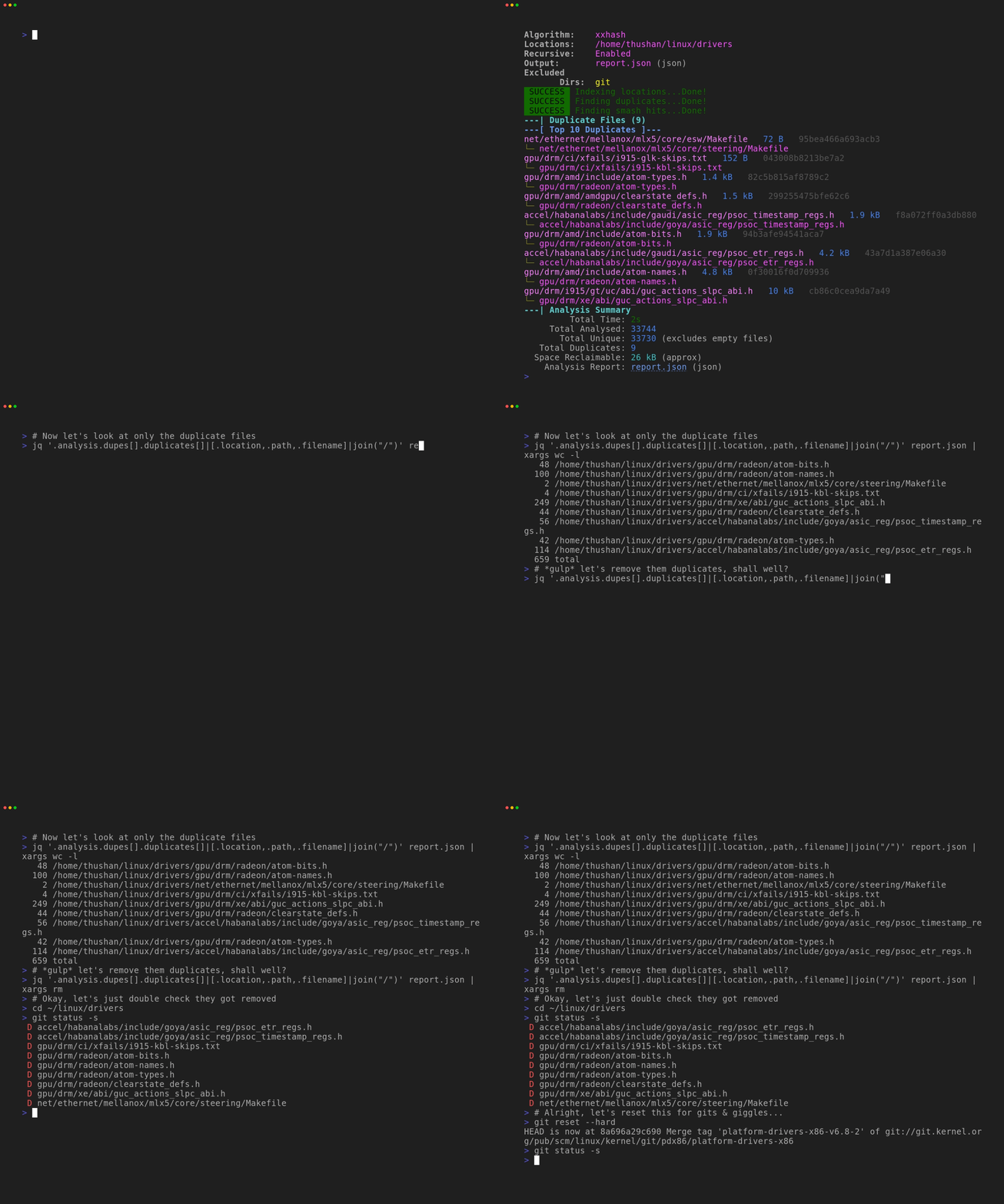
Find duplicates in the linux/drivers source tree with smash (see our 🍿 other demos). Made with vhs!
The name comes from a prototype tool called SmartHash (written many years ago in C/ASM that's now lost in source & too hard to modernise). It operated on a similar concept of slicing and hashing (with CRC32 then later MD5).
Installation

You can download the latest binaries from Github Releases or via our simple installer script - which currently supports Linux, macos, FreeBSD & Windows:
bash <(curl -s https://raw.githubusercontent.com/thushan/smash/main/install.sh)
It will download the latest version & extract it to its own folder for you.
Alternatively, you can install it via go:
go install github.com/thushan/smash@latest
smash has been developed on Linux (Pop!_OS & Fedora), tested on macOS, FreeBSD & Windows.
Docker
You can also run smash using Docker. Multi-architecture images (amd64/arm64) are available on GitHub Container Registry:
[!TIP] Use the
-tflag to allocate a pseudo-TTY for better output formatting with Docker.We use the
--rmflag to automatically remove the container after it exits, keeping your environment clean in these examples.
# Pull the latest image
docker pull ghcr.io/thushan/smash:latest

# Scan current directory
docker run -t --rm -v "$PWD:/data" ghcr.io/thushan/smash:latest -r /data

# Scan with output file (saves to current directory)
docker run -t --rm -v "$PWD:/data" ghcr.io/thushan/smash:latest -r --silent -o /data/report.json /data

# Use the built-in /output directory (container includes a writable /output)
docker run -t --rm -v "$PWD:/data" -v "$PWD/output:/output" ghcr.io/thushan/smash:latest \
  -r --silent -o /output/report.json /data

# Or create your own output directory
mkdir -p my-reports
docker run -t --rm -v "$PWD:/data" -v "$PWD/my-reports:/output" ghcr.io/thushan/smash:latest \
  -r --silent -o /output/report.json /data

# Scan multiple directories with output
docker run -t --rm \
  -v "$HOME/Documents:/docs:ro" \
  -v "$HOME/Pictures:/pics:ro" \
  -v "$PWD/output:/output" \
  ghcr.io/thushan/smash:latest -r -o /output/report.json /docs /pics

# Windows PowerShell example
docker run --rm -v "${PWD}:/data" -v "${PWD}/output:/output" ghcr.io/thushan/smash:latest `
  -r --silent -o /output/report.json /data

# Use a specific version
docker pull ghcr.io/thushan/smash:v1.0.0
Important notes:
- Output files must be written to mounted volumes (e.g.,
/dataor/output) - Use
:rofor read-only mounts when you only need to scan directories - The container runs as non-root user, so ensure output directories are writable
The Docker image is based on Alpine Linux for a minimal footprint (~8MB) and runs as a non-root user for security.
Usage
# Basic usage - scan current directory
smash

# Recursive scan
smash -r

# Scan multiple directories
smash -r ~/Documents ~/Downloads

# Silent mode with report
smash -r --silent -o report.json ~/data
For detailed usage, see the User Guide.
Command Line Options
Key flags:
-r, --recurse- Scan subdirectories (required for recursive scanning)-o, --output-file- Save results to JSON file--silent- Suppress all output except errors--algorithm- Choose hash algorithm (default: xxhash)--exclude-dir- Skip directories (comma-separated)--exclude-file- Skip files (comma-separated patterns)
Run smash --help for complete options.
Quick Examples
Find Duplicates
# In photos directory
smash -r ~/photos -o duplicates.json

# Across multiple drives
smash -r ~/Documents /mnt/backup/Documents

# Large video files only
smash -r --min-size=104857600 ~/Videos
Filter and Exclude
# Skip git and node_modules
smash -r --exclude-dir=.git,node_modules ~/projects

# Include empty files
smash -r --ignore-empty=false ~/data
Performance Tuning
# For network drives
smash -r --max-workers=4 /mnt/nas

# For many small files
smash -r --disable-slicing ~/documents
Working with Reports
# Generate report
smash -r ~/data -o report.json

# List all duplicates
jq -r '.analysis.dupes[].files[].path' report.json

# Show space wasted
jq '.analysis.summary.spaceWasted' report.json
See the User Guide for detailed examples and advanced usage.
Contributing
We welcome contributions! Please see our Developer Guide for information on:
- Building from source
- Running tests
- Development workflow
- Docker development
- Release process
Acknowledgements
This project was possible thanks to the following projects or folks.
- @jqlang/jq - without
jqwe'd be a bit lost! - @wader/fq - countless nights of inspecting binary blobs!
- @cespare/xxhash - xxhash implementation
- @spaolacci/murmur3 - murmur3 implementation
- @puzpuzpuz/xsync - Amazingly efficient map implementation
- @pterm/pterm - Amazing TUI framework used
- @spf13/cobra - CLI Magic with Cobra
- @golangci/golangci-lint - Go Linter
- @dkorunic/betteralign - Go alignment checker
Testers - MarkB, JarredT, BenW, DencilW, JayT, ASV, TimW, RyanW, WilliamH, SpencerB, EmadA, ChrisE, AngelaB, LisaA, YousefI, JeffG, MattP
License
Copyright (c) Thushan Fernando and licensed under Apache License 2.0
 Documentation

Documentation


There is no documentation for this package.
 Source Files
 Directories